

A late-stage deal starts to drift. The CRM still says active. The forecast category has not changed. The last call note says the buyer is waiting on finance. Slack has a teammate saying the champion may have left. The warehouse score dropped overnight because product activity went quiet.
At this point, an agent may have enough context to understand the problem. It can cite the call note, compare the score change, read the CRM stage, and identify the Slack signal. That is useful, but it is not enough.
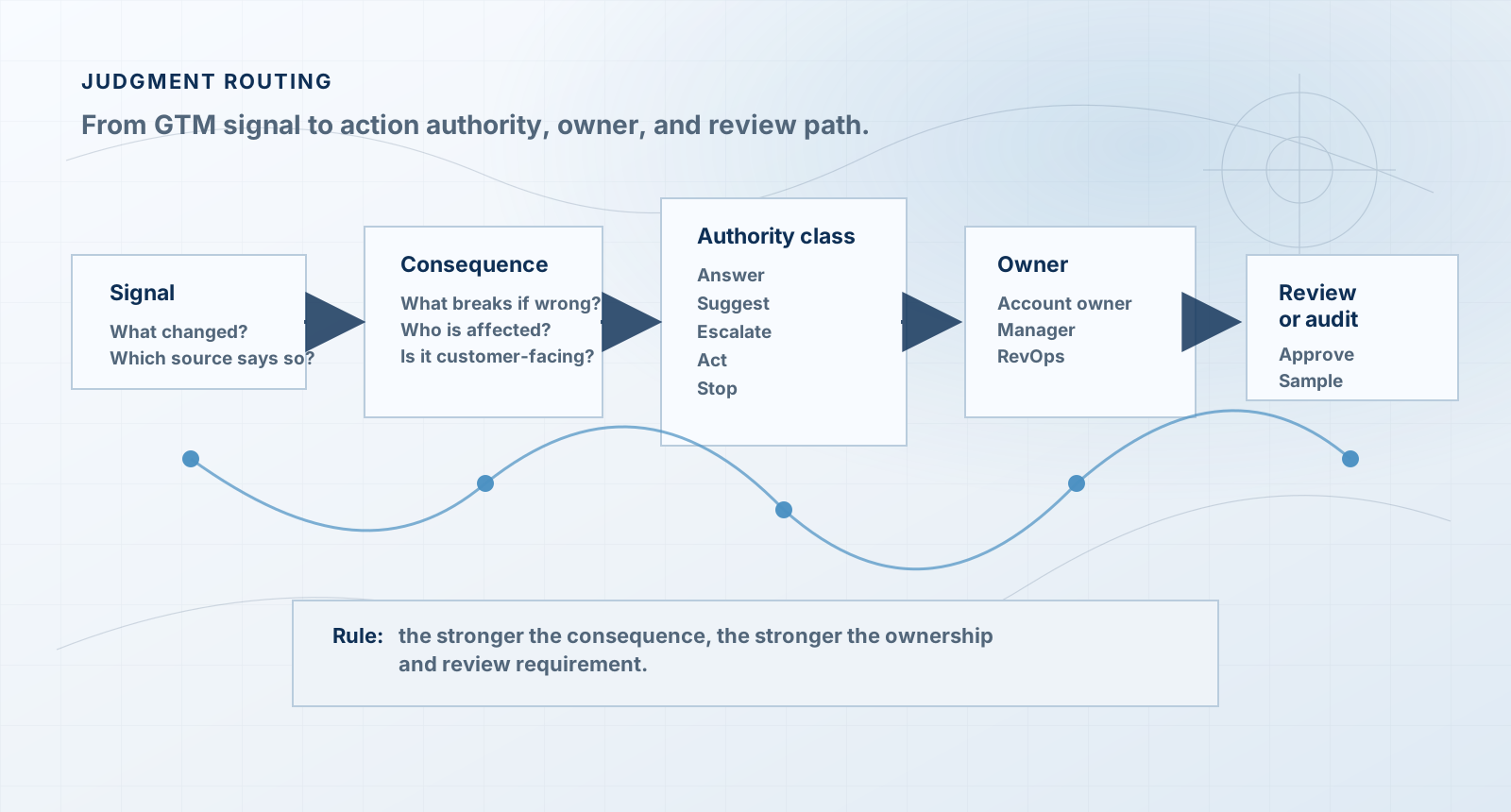
The business still has to decide what kind of authority the system has. Can it answer a question? Suggest a next step? Escalate to a manager? Change a field? Pause automation? Stop because the sources disagree?
Context is not authority.
Context is not authority
The last piece was about field ownership. If an agent reads a field, the system needs to know what the field means, who owns it, and what review rule applies before the value influences revenue work.
This layer is different. The question is no longer whether the agent can trust the context. The question is what the agent is allowed to do once the context is trustworthy.
That distinction matters because GTM systems do not fail only when data is wrong. They also fail when the next action is too strong for the evidence, routed to the wrong owner, or allowed to move before the business has agreed who carries the consequence.
The five action classes
The action class is the useful unit. A team can say yes to one class and no to another without rejecting agents entirely.
A read-only answer is often safe if the agent shows its sources. A suggestion can be useful when it stays internal: draft the follow-up, create the review item, prepare the note. Escalation is different because it changes attention and priority. Acting is different again because it changes the system of record or triggers downstream work. Stop is not a failure; it is the system recognizing that the authority boundary has been reached.
This is where a lot of agent demos skip the hard part. They show a recommendation and imply the next step is obvious. In a real revenue workflow, the next step is rarely obvious until consequence, ownership, and reversibility are known.
Why consequence matters
The same signal can require different treatment depending on the consequence of being wrong.
If an agent sees an inactive contact on a small early-stage account, an internal note may be enough. If it sees buyer silence on a late-stage enterprise deal that affects forecast, it should probably escalate with evidence and ask for review. If it sees a lifecycle stage conflict that would change campaign membership, it should stop before anything downstream moves.
Renewal risk is another example. An agent may notice lower product usage, unresolved support activity, and a sponsor change. It can summarize the risk. It can suggest questions for the account owner. It can escalate internally. But it should not automatically trigger customer-facing outreach unless the business has explicitly approved that action class.
Account routing works the same way. If ICP segment, score, and owner assignment disagree, the useful action is not to pick a winner. The useful action is to pause the handoff and route the conflict to the owner of the rule.
The question is not whether the agent is right. The question is what happens if the agent is wrong.
What RevOps can actually build
A practical judgment layer starts with a small authority map for the workflows closest to revenue: pipeline review, renewal risk, lifecycle movement, routing, customer communication, and manager escalation.
For each workflow, define the action classes. What can the agent answer without review? What can it draft but not send? What should it escalate? What can it write only inside a pre-approved boundary? What should make it stop?
Then attach the operating details: the owner, the evidence required, the review trigger, the log, the rollback path, and the rule-change owner. This is how the judgment layer becomes more than a prompt. It becomes a control surface for revenue work.
Who audits the rules
The compliance question underneath this is the right one: who audits the rules that audit the agent?
The answer cannot be an infinite loop of agents checking agents. Agents can inspect actions against the current rule set. They can log decisions, flag exceptions, and compare behavior against policy. But the rules themselves need human-owned controls.
That means version history, approval rights, sampling, exception review, and a named owner for changing the authority map. A review agent can help spot drift. It should not be the final authority over the rules that govern it.
Meta-governance is bounded review with human ownership.
Where this goes next
The judgment layer is only useful if the system knows what deserves attention in the first place. Otherwise the authority map becomes a polished way to route too many low-value signals.
That is the next layer: novelty detection. Not novelty as a gimmick, but as an attentional layer for GTM systems. What changed? What is unusual? What is material? What can be ignored? What should be reviewed before it becomes a workflow?
Field ownership tells the system what it can trust. Judgment tells it what it can do. Novelty detection decides what is worth bringing to the system at all.
Accountability starts before action. It starts with deciding what deserves attention.