

These are not edge cases: the CRM has one version of the account, the warehouse has another, enrichment adds a third, call intelligence captures something newer, and sales engagement logs a behavior that no one has reconciled yet.
That is not a broken GTM stack. That is the normal operating condition of any GTM stack with multiple data sources, and every GTM stack has multiple data sources.
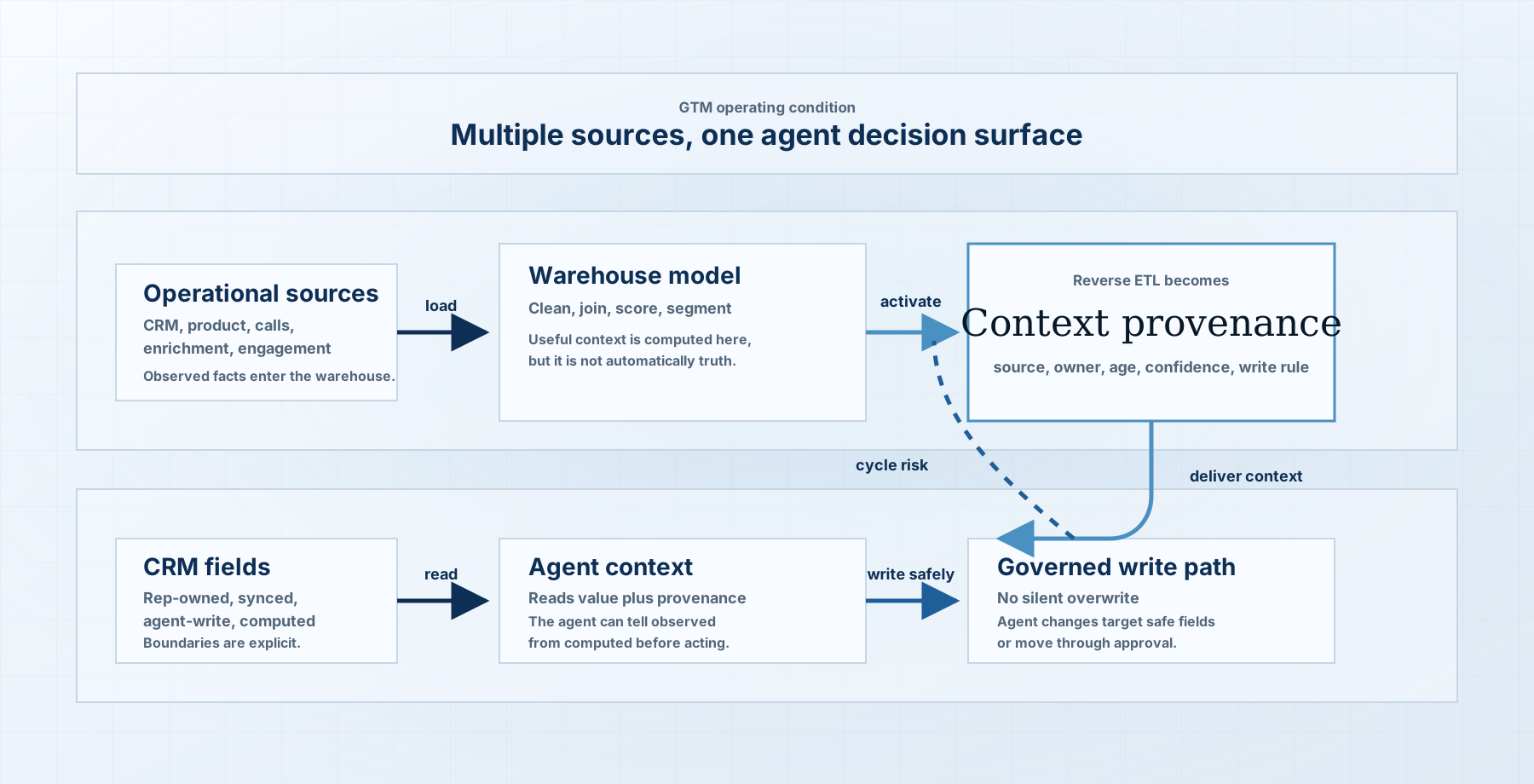
The existing stack of articles mapped three pieces of the agent-native architecture: the agent-ready CRM interface, the missing coordination layer between tools and agents, and the interface selection problem between MCP and CLI. The missing piece, the one that makes all of those surfaces trustworthy, is the context provenance layer.
Reverse ETL becomes more important when it stops being only a sync tool and starts becoming an agent context delivery system.
Reverse ETL Was Always About Action
The old explanation for reverse ETL was simple: extract data from the warehouse and load it back into operational tools. In practice, that meant sending modeled data into a CRM, marketing automation platform, support system, ad platform, or sales tool where someone could actually use it.
The term was awkward, and the marketing around it often made the category sound more mysterious than it was. But the pattern was real. Clean the data, model it, and put the useful version in the workflow where a person can act on it.
That is why reverse ETL mattered for GTM. A warehouse table on its own does not change pipeline. A segment that reaches sales, marketing, customer success, or RevOps can change what the team does next.
Agents Change The Job
What changes with agents is that the "someone" using the context is no longer only a person. It may be software deciding whether an account is worth researching, whether a deal risk should be escalated, whether a CRM field should be updated, or whether a sequence should be paused.
A person can sometimes look at a field and infer that it came from a model, that it is probably stale, or that it should not override a rep's note. An agent needs that distinction made explicit.
It needs to know whether a value is observed or computed, whether it came from the source system or the warehouse, when it was refreshed, which system owns it, whether it can be overwritten, and whether acting on it will create a downstream side effect.
The agent does not just need the value. It needs the reason to trust or distrust the value.
The Convergence Problem
A useful warning came up in a data engineering discussion about reverse ETL. If a company pulls from operational systems into the warehouse and also pushes from the warehouse back into operational systems, it can accidentally create an implicit cycle.
The warehouse becomes a synthesis of data the warehouse helped create. The CRM becomes a mix of human-entered facts, source-system observations, modeled outputs, and fields that were changed because a previous model said they should change.
That warning matters even more in an agent-native stack. If an agent reads a field that was synced from the warehouse, takes an action that updates a different CRM field, and the warehouse later picks up that update and recomputes the first field, the agent may be operating inside a closed loop with no external reference point.
The problem is not reverse ETL. The problem is unmarked provenance and unclear field ownership.
The Fix Is Field Governance
A GTM stack needs more than a sync configuration. It needs a field governance model that agents can understand. Warehouse-synced fields should be marked as warehouse-synced. Computed fields should be marked as computed. Observed source fields should preserve their source. Rep-owned fields should not be silently overwritten by a scheduled pipeline. Agent-write fields should be narrow, explicit, and auditable.
This sounds like RevOps hygiene, but it becomes agent safety infrastructure. If an agent cannot distinguish between a rep-owned note and a modeled propensity score, it cannot reason responsibly about what to trust or what to change.
The reverse ETL layer is a natural place to carry that context because it already sits between the warehouse and the operational tool. It knows the model that produced the value, the destination field, the sync cadence, and the write behavior. That metadata should become part of the contract.
What The Provenance Layer Should Carry
The useful payload is not just "account score equals 84." It is: this score was computed in the warehouse, from these source systems, using this model, refreshed at this time, owned by this workflow, and allowed to update this CRM field under these conditions.
For an agent, that changes the decision. A fresh observed value from the CRM may deserve different treatment than a stale computed score. A product usage signal may be safe to summarize but not safe to overwrite. A warehouse segment may be useful for prioritization but not strong enough to trigger a destructive CRM write.
This is where reverse ETL becomes the data layer's interface to the agent stack. It should ship values with source, freshness, ownership, confidence, write policy, and conflict behavior.
A Practical Operating Model
The practical version is not complicated. Treat the warehouse-to-CRM path as a one-way context delivery layer unless there is a deliberate exception. Do not let syncs overwrite fields that humans or agents have changed between cycles. Keep computed fields separate from source-observed fields. Keep rep-owned fields separate from model-owned fields. Let agents read broadly, but write narrowly.
If the agent wants to act on a warehouse-derived value, it should be able to inspect the provenance first. If the provenance is stale, ambiguous, or model-owned, the agent should either ask for fresher context, route through approval, or write to a separate proposed action field instead of mutating the operational record directly.
That is the difference between a sync tool and an agent context delivery system.
The Bigger Point
Reverse ETL was never really about moving data. It was about putting context where it can be acted on.
The reverse ETL tools that matter in agent-native GTM will not just be better at sync performance. They will become the data layer's interface to the agent stack, carrying the metadata, provenance, and governance that agents need before they act on anything.
The data layer is becoming a context layer. Context without provenance is just another field the agent has to guess about.