

The last article was about the broad operating conditions: access, truth, boundaries, judgment, and review. That is the right starting point, but it is still too abstract to run a GTM system.
The next layer down is where those rules live day to day: in the fields that decide routing, prioritization, forecast, handoff, and customer communication.
Not because fields are complicated. Most people understand what a CRM field is. The deeper point is that GTM fields are not just data containers. They are business decisions disguised as data.
A lifecycle stage decides what motion an account belongs in. A segment decides which market strategy applies. An account score decides what deserves attention. A next-step field decides who owes action. A source field decides what evidence the team is allowed to trust.
Once software starts reading those fields and proposing actions from them, field ownership becomes much more than CRM hygiene. It becomes the contract between GTM strategy, RevOps, sales execution, and the agent layer.
A field is only useful to an agent when its business meaning is clear.
Fields become operating rules
The useful question is not what a field is. The useful question is whether the organization has decided what its most important fields mean, who owns their meaning, and what software is allowed to do with them.
If a field affects routing, scoring, handoff, prioritization, lifecycle movement, or customer communication, it is no longer a passive record. It is part of the operating model. That means it needs a contract.
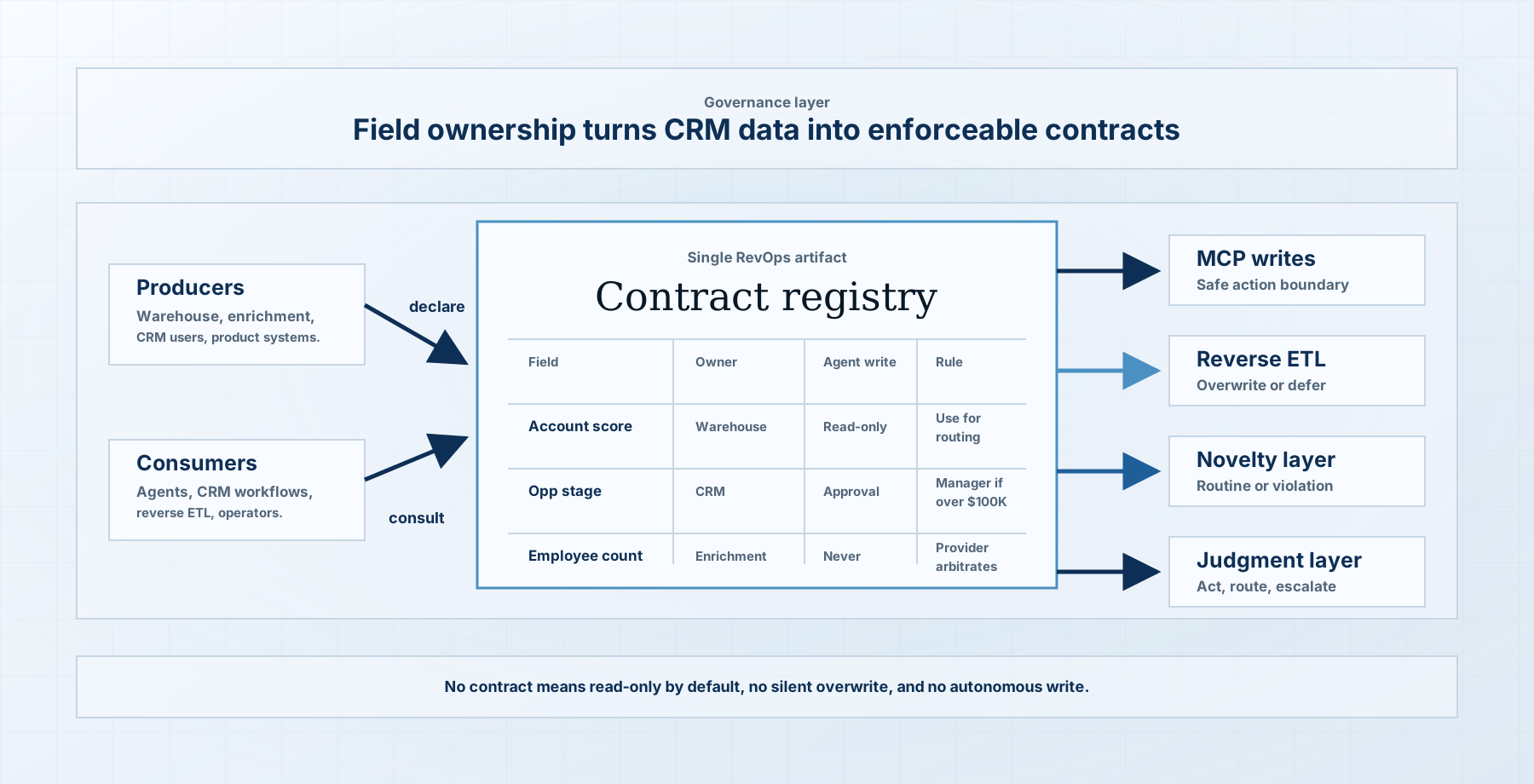
A field contract is a small agreement around a specific value: what the field means, who owns it, where the value comes from, who can change it, what the agent can do with it, and when review is required.
Field contract registry
A working model for deciding whether agents, syncs, and workflows can touch a GTM field.
| Field | Business Meaning | Owner | Agent Can | Review Trigger |
|---|---|---|---|---|
| Lifecycle stage | Which commercial motion the account is in. | Sales / RevOps | Suggest change with evidence. | Stage change affects forecast, campaign, owner, or handoff. |
| ICP segment | Which market thesis and routing logic applies. | GTM strategy | Use for prioritization and routing. | Segment criteria conflict with recent account evidence. |
| Account score | Why this account deserves attention now. | RevOps / data | Read, cite, and explain. | Score drives outreach, escalation, or territory movement. |
| Next step | Who owes action and what should happen next. | Account owner | Draft or propose task. | Action becomes external or changes customer-facing motion. |
| Source / evidence | Why the system believes the field is true. | Data / RevOps | Require citation before recommendation. | Agent cannot show where the claim came from. |
This is the part I think matters most: the contract is not just technical. It carries the company's GTM judgment. It says which signals matter, which team owns the interpretation, and where software is allowed to participate.
Why this matters in RevOps
RevOps already lives in this tension. A field looks like a simple column until it starts deciding campaign membership, owner routing, pipeline reporting, sales handoff, renewal risk, or customer communication.
That is why this is not only a data-quality problem. It is a go-to-market design problem. If the lifecycle stage is unclear, the GTM motion is unclear. If the segment definition is weak, the market motion is weak. If account score has no owner, prioritization becomes opinion dressed up as automation.
Agents make this more urgent because they compress the distance between reading a field and acting on it. A person might read a score, think about it, ask around, and decide what to do. An agent can move from score to recommendation to workflow in seconds. That only works if the field already carries clear ownership and review rules.
A field contract is the difference between access and authority.
How this builds on the last article
The last article argued that agents need five operating conditions: access, truth, boundaries, judgment, and review. Field ownership is how several of those conditions become concrete.
- Truth becomes a source and ownership rule for each important field.
- Boundaries become a permission rule for whether the agent can read, draft, suggest, or write.
- Review becomes an escalation rule for fields that affect revenue motion.
This is also where the compliance question starts to show up. If an agent follows a field rule, who makes sure the field rule itself is still correct? That cannot be left to the same agent that wants to act. The rule layer needs review: version history, owner approval, sampling, exception queues, and periodic governance.
The agent can follow the rule. The business has to own the rule.
What RevOps owns here
In this model, RevOps is not just cleaning fields or maintaining integrations. RevOps owns the operating rules that decide whether data can be trusted and whether software can act.
That means owning the contract registry, reviewing exceptions, resolving ownership disputes, and deciding which actions can move from proposal to automation. It also means working with sales, marketing, data, and product so the revenue system has one shared version of what each important field means.
RevOps becomes the owner of operational truth, not just CRM hygiene.
What someone can actually take from this
If you are building or evaluating an agentic GTM system, do not start by asking whether the model can write to the CRM. Start by auditing the fields that drive the motion.
Pick the fields that decide routing, prioritization, forecast, handoff, campaign entry, customer communication, and escalation. For each one, ask:
- What business decision does this field drive?
- Who owns the meaning of the field?
- Where does the current value come from?
- What can an agent safely do with it?
- When does a person need to review before action?
- Who audits changes to the rule itself?
That exercise is more useful than another AI demo. It tells you whether the revenue system is ready for agents to do more than summarize.
The takeaway
Field ownership is not the final judgment layer. It is the layer judgment depends on.
Before an agent can decide whether to answer, suggest, escalate, or act, the system has to know what the field means, who owns it, and whether the agent has authority to use it for that decision.
That is the value of the field contract. It turns GTM assumptions into operating rules. It gives RevOps something to govern. It gives the agent a boundary. And it gives the next article, the judgment layer, something solid to reason from.
The practical test is whether the field can explain the decision it is about to influence.